What Problem This Solves
AI-generated artifacts can fail for many reasons: incomplete requirements, hidden platform constraints, dependency ordering issues, or environment-specific behaviors. Instead of treating each failure as an isolated incident, the platform captures these failures and learns from them systematically.
How Self-Evolving AI Works
Rather than making uncontrolled changes, the system learns from real-world execution failures, proposes targeted fixes, and applies improvements only through a supervised approval workflow.
Automatic Detection
Failed runs, validation errors, and generation issues are detected automatically
AI-Assisted Analysis
System analyzes logs, task history, and error messages to identify recurring patterns
Fix Proposal
AI proposes targeted improvements to generation logic, validation rules, or dependency handling
Human Review
Proposed fixes require explicit administrative review and approval
Controlled Deploy
Approved fixes are deployed in a controlled manner
Auto Re-process
Impacted requirements reprocess automatically using the improved logic
Peek Inside the Platform
Real screenshots from our supervised, self-evolving AI system
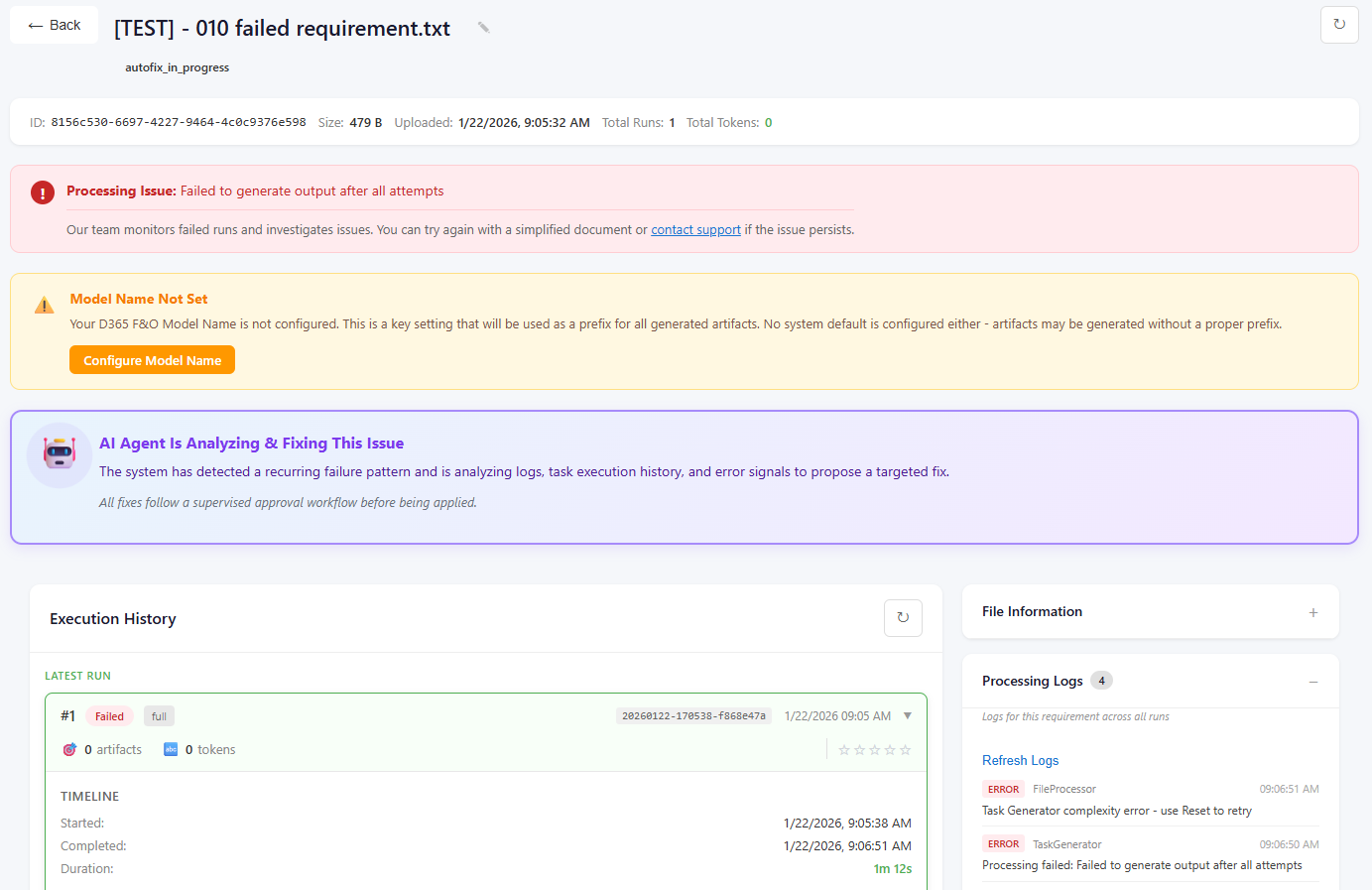
Supervised Auto-Fix Analysis
Users see real-time status as the system analyzes execution failures and identifies recurring error patterns. AI proposes targeted fixes, which are reviewed and approved before deployment. Typical analysis and resolution completes within 5–15 minutes, with full transparency throughout the process.
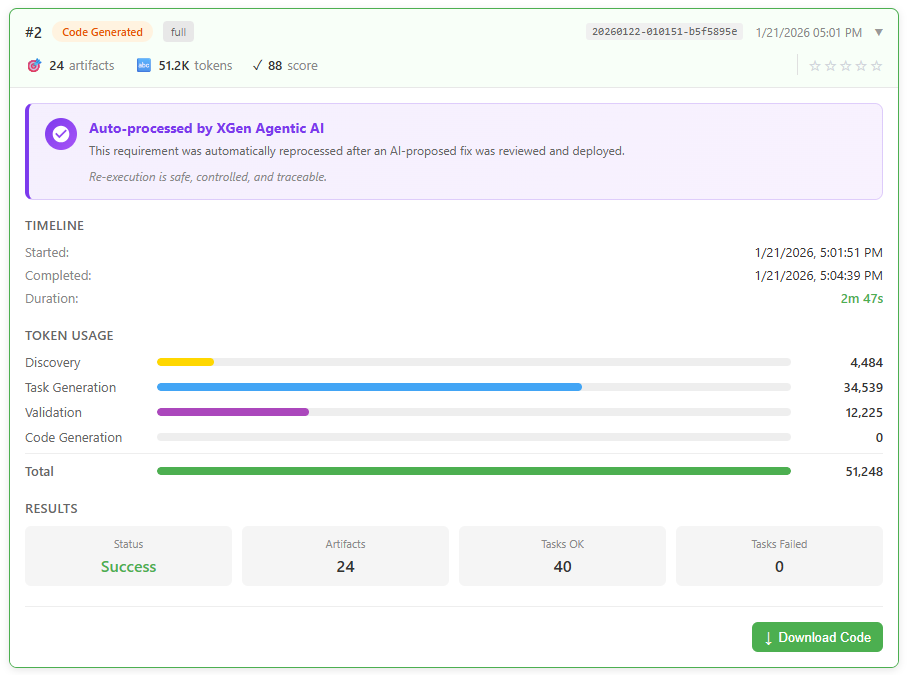
Automatic Reprocessing After Approved Fixes
Once a fix is reviewed and deployed, affected requirements are automatically reprocessed using the improved logic. In this example, 19 artifacts were regenerated in 2 minutes 30 seconds, with no manual retriggering required. All reprocessing is controlled, traceable, and based on approved changes.
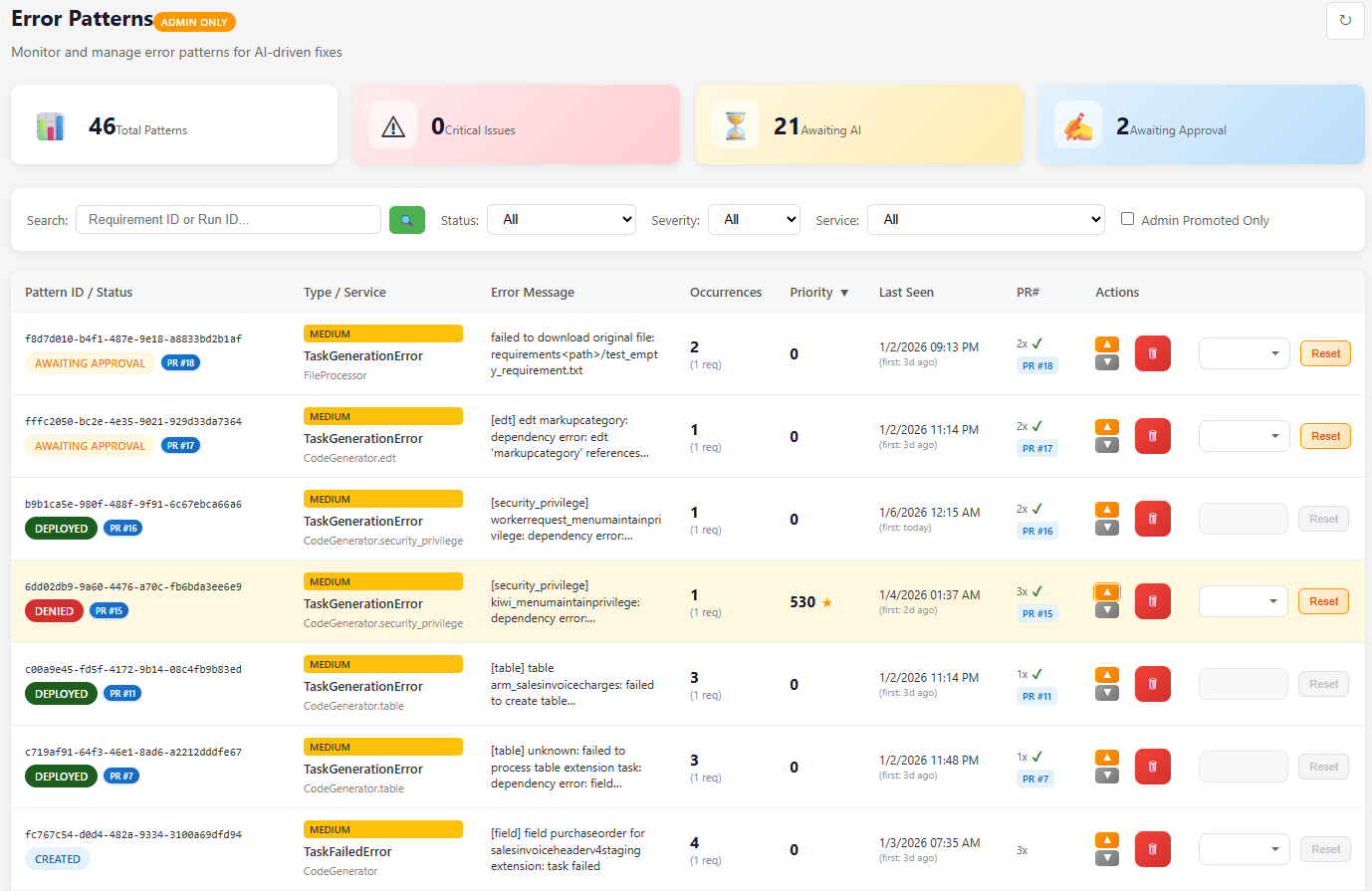
Centralized Error Pattern Intelligence
Errors are aggregated across all runs and environments, tracked by frequency, severity, and impact. The system manages the full lifecycle — from detection and analysis, to approval and controlled deployment — ensuring continuous improvement without unpredictable behavior.
Governance & Safety Model
Self-evolution does not mean uncontrolled behavior.
| Stage | Control |
|---|---|
| Detection | Automatic |
| Analysis | AI-assisted |
| Fix Proposal | AI |
| Approval | Human |
| Deployment | Controlled |
| Re-execution | Automatic |
What "Self-Evolving" Means
Understanding the scope and boundaries of this capability
It means:
- Learning from real execution failures
- Reducing repeat errors over time
- Improving generation accuracy through approved fixes
It does NOT mean:
- Unreviewed code changes
- Autonomous deployment without oversight
- Modifying customer environments directly
Why This Matters
Self-Evolving AI complements — rather than replaces — developer expertise
Fewer Repeated Failures
Errors fixed once stay fixed across all projects
Continuous Improvement
Driven by real usage, not theoretical scenarios
Higher Trust
In AI-generated artifacts through proven reliability
Reduced Manual Effort
Less troubleshooting, more productive work
24/7
Autonomous Monitoring
<15min
Average Fix Time
100%
Automatic Reprocessing
Experience Self-Evolving AI
Our Artifact Generator is powered by this self-evolving AI system. Issues that would traditionally require support tickets are identified, analyzed, and resolved through a controlled improvement process.
Try XGen CloudForgeThis capability is continuously refined as part of the platform's long-term vision, while current releases remain focused on developer-controlled, AI-assisted workflows.